Four focus words at a time.
A word leaves focus once I use it freely, or after three sessions. Each session also introduces two new words.
ChatGPT voice practice,
with a saved record.
I’m practising Zürich German before I move to Switzerland on 1 May 2027. I talk to ChatGPT in voice mode. With AI agents, I made a small app that gives those chats a memory.
It’s a personal tool, in use since November 2026. It’s too early to say whether it improves my speaking.
Screenshots use synthetic demo data · The app itself stays private
I practise inside a ChatGPT Project, mostly by voice. Each new chat began with no memory of the last one. For about ten days I drilled the same Swiss German words. When I said “let’s move on”, the next day’s chat had forgotten.
The coach needed a record it could read at the start of a chat and write to at the end.
ChatGPT does the talking. The app keeps the record.
I practise in a ChatGPT Project. The coach calls the app’s tools as we talk.
A small Python MCP server, connected to ChatGPT as an app. It runs on my own Hetzner server behind HTTPS.
Words, results, corrections, debriefs and benchmarks in one file, backed up nightly.
On Sunday evenings Hermes, my assistant agent, checks pace against the milestones and can swap focus words.
| Tool | When, and what it saves |
|---|---|
| start_session | First in every chat. Returns the mission, the last three debriefs and today’s plan: four focus words, two new ones, light review. |
| finish_session | When I’m done. Saves a full debrief for the next chat, up to three priorities, and anything not yet saved. |
| update_focus | When I say “let’s move on”. Those words leave focus for good; focus refills itself. |
| log_mistake | After a correction: what I said, the fix, a category. |
| review_word | When I use or miss a tracked word: free, with help, or missed. Schedules the next review. |
| log_words | When a useful new word comes up. |
| log_benchmark | Sundays. Anything not measured stays empty. |
Two read-only tools list due words and progress. The coach records quietly and must never invent minutes, scores or pronunciation judgements.
The rules live in the app, not in a chat.
A word leaves focus once I use it freely, or after three sessions. Each session also introduces two new words.
When I’m done with a word, that decision is stored for every later chat. The word stays in light review.
Only an unprompted new sentence counts as free use. A word is secure after free use on three different days; reviews space out from one day to two months.
A read-only page the app renders from the same record.
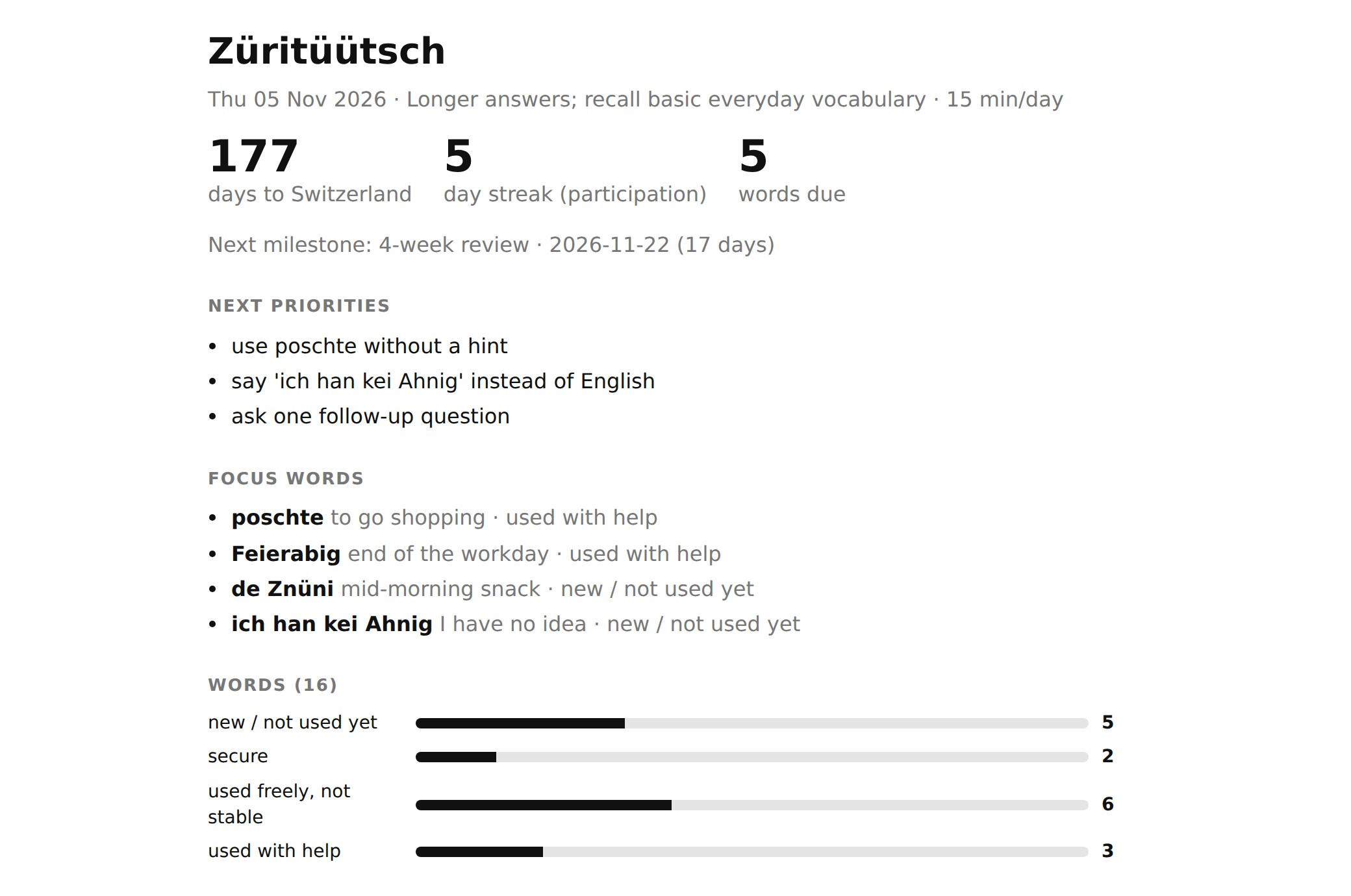
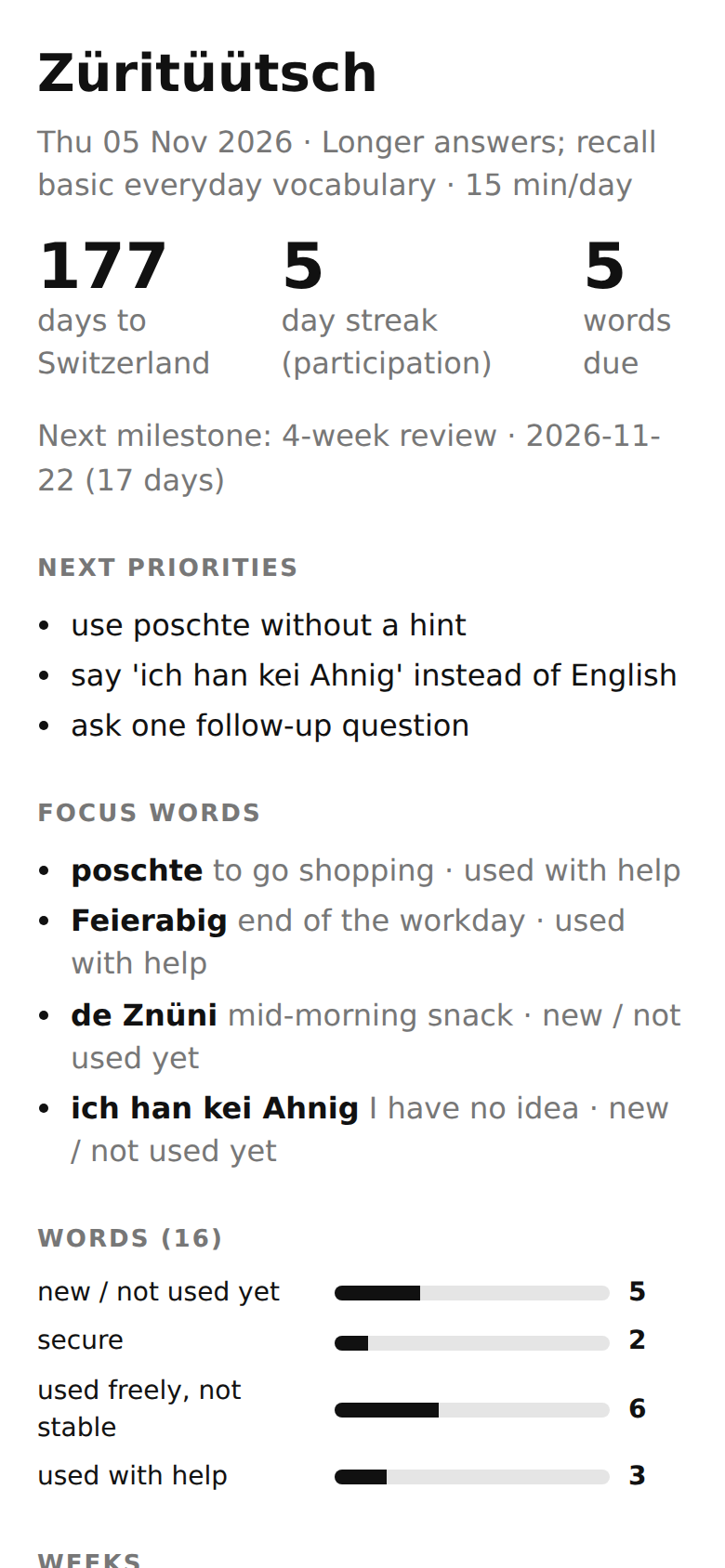
My own provisional targets, not a certification.
The goal: by 1 May 2027, hold a 20-minute unscripted everyday conversation in Zürich German, with no more than two English rescues per 10 minutes.
Every Sunday the coach runs a short benchmark: ten unfamiliar everyday questions, counting first-try answers and English rescues. Anything not measured is saved as empty. The streak counts practice days, not proficiency.
Each chat opens with the last debriefs and today’s plan, and a “move on” is stored for the next day. Corrections and word results build into one record I can look at.
Weekly benchmarks have run since 8 November, and two are done. The coach works and has taught me new words, but progress is slow: I still fall back on Standard German more than Zürich forms. The coach still has to call the tools; if it doesn’t, nothing is saved. Pronunciation isn’t judged.
I chose the problem, decided what the coach should remember, set the coaching and honesty rules, and review how it behaves in my own sessions. AI agents implemented the server, the data model and the deployment. I don’t hand-code it.
Storing data was the easy part. The question was what the next chat needs to know: what we talked about, what’s done, and what not to repeat.
A preference said in a chat is easy to lose, so “let’s move on” became a saved decision.
Repeating after the coach looks like progress, so it doesn’t count as free use.
On 22 November I look back over four weeks of benchmarks. Planned, not completed.
An open-source version, with synthetic demo data and setup notes, is on GitHub under the MIT license. My own server and data stay private.
LinkedIn or student email.