Mandate.
A paper-trading desk
where the rules come first.
Work in progress · Paper money only
Mandate is a small trading desk for one person, on paper money. A strategy proposes a trade, a written set of limits (the mandate) checks it, a new position is meant to wait for the owner’s approval on a phone, and every step lands in a log that shows tampering.
It is unfinished. It has run every weekday on paper since 9 November 2026. On 24 November a one-share test order was bought and sold at each of two brokers’ paper accounts. It has never placed a real-money order. Nothing here is advice.
Screenshots use synthetic data · The desk itself stays private
- Daily paper run since
- 9 Nov 2026
- Paper books
- 14, in three groups
- Automated tests
- 1,176 passing on 25 Nov 2026
- Real-money orders
- None
The record
First daily paper run: prices for six ETFs, one monthly rule, a log that shows tampering.
RunningThe Desk starts: about five yes-or-no forecasts each US trading day, published with their scores.
RunningTest orders at two brokers’ paper accounts: one SPY share bought and sold at each. Both accounts were flat afterwards.
DonePaper trading scheduled: morning order jobs, an evening run that asks for my approval, a daily crypto run.
RunningEight experiment books started: six rule-based and two buy-and-hold benchmarks.
RunningThree day-trading ideas audited against pass marks written down first. All three failed
Failed, keptA code review found four faults, among them morning order jobs timed to run before the US market opened. All four were fixed the same day.
FixedThe five ETF experiment books send their first practice orders to a broker’s paper account.
Planned, not done
- Forecasts logged
- 40
- Settled
- 23
- Daily runs completed
- 8 of 8
- Record as of 28 Nov 2026
- 23 settled forecasts: no claim of beating a baseline before 100. The Desk’s daily record
Each line comes from a dated handoff note written when the work was done. The three Desk counts are read from its public export when the site is built.
The question
What should stop
a trade?
Base Rates counted how often a market move has happened. The Research Lab tested whether a simple written rule holds up on years it was not fitted to.
Mandate is about the controls around a decision: which limits apply, who signs off, what record is kept, and how everything stops. In asset management, a mandate sets out what a manager may and may not do with a client’s money. This project asks what it takes for a program to enforce one.
How it works.
The strategy asks. The mandate checks, then the owner decides.
A strategy proposes
After the US close, a simple ETF momentum rule, a variant of one in the Research Lab, reads the day’s prices and proposes paper orders. It cannot place them.
The mandate checks
Fourteen written rules: which ETFs, how large, a stop on every entry, trades per day, a daily loss halt. One failed rule rejects the proposal.
The owner decides
On the broker-paper books a new position always waits for me. The evening run sends me an alert with a link; I log in and approve or reject, which spends a single-use token. Exits need no approval: they only reduce risk. The experiment books approve themselves.
Fill, record, reconcile
An approved order fills at the next US open in the internal paper ledger, with modelled fees and slippage, or goes to a broker’s paper account just after the open at the broker’s own fill. After each morning run the broker account is compared with the books; a mismatch engages the kill switch. Every step is a row in the audit log.
Every limit lives in one file. Its fingerprint is stored with each proposal, so the log shows which version of the rules a decision was checked against.
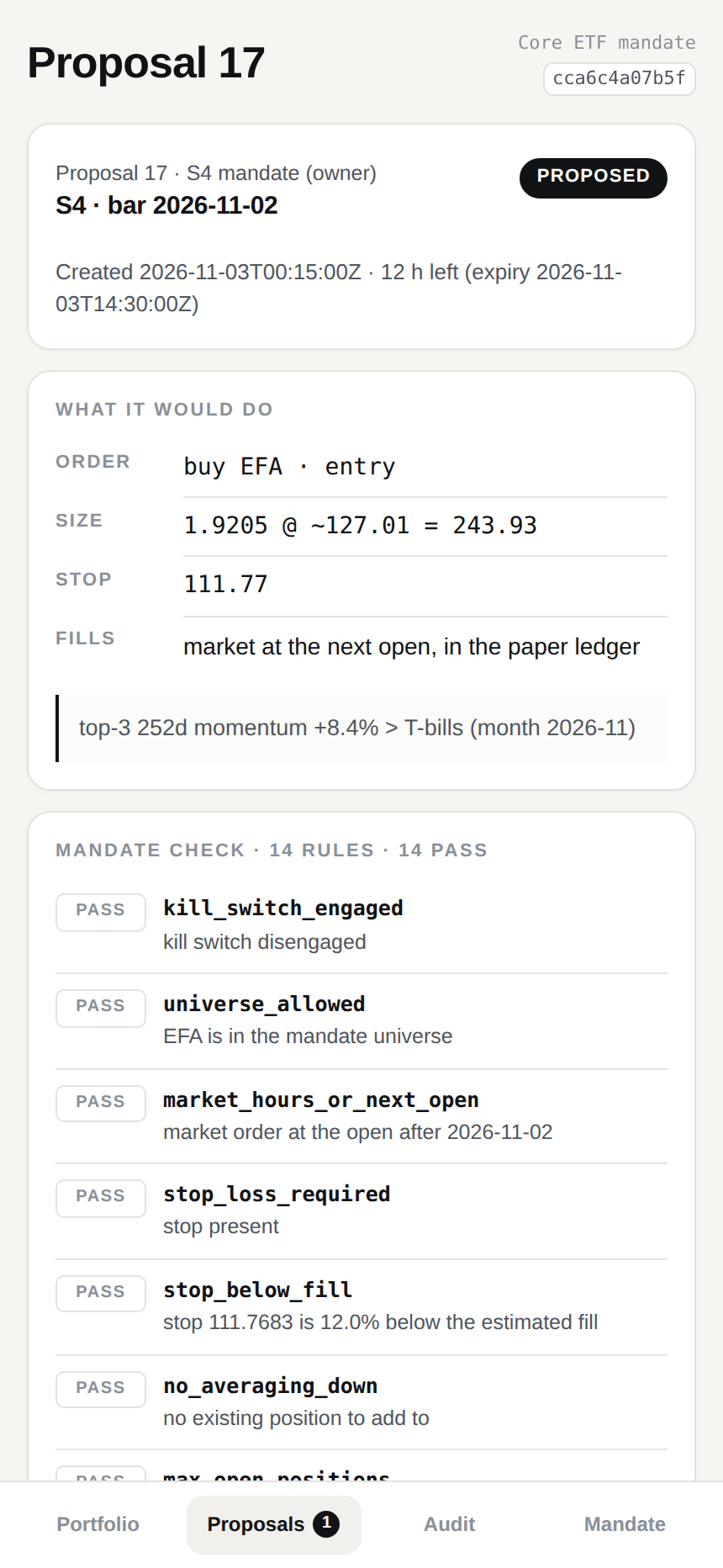
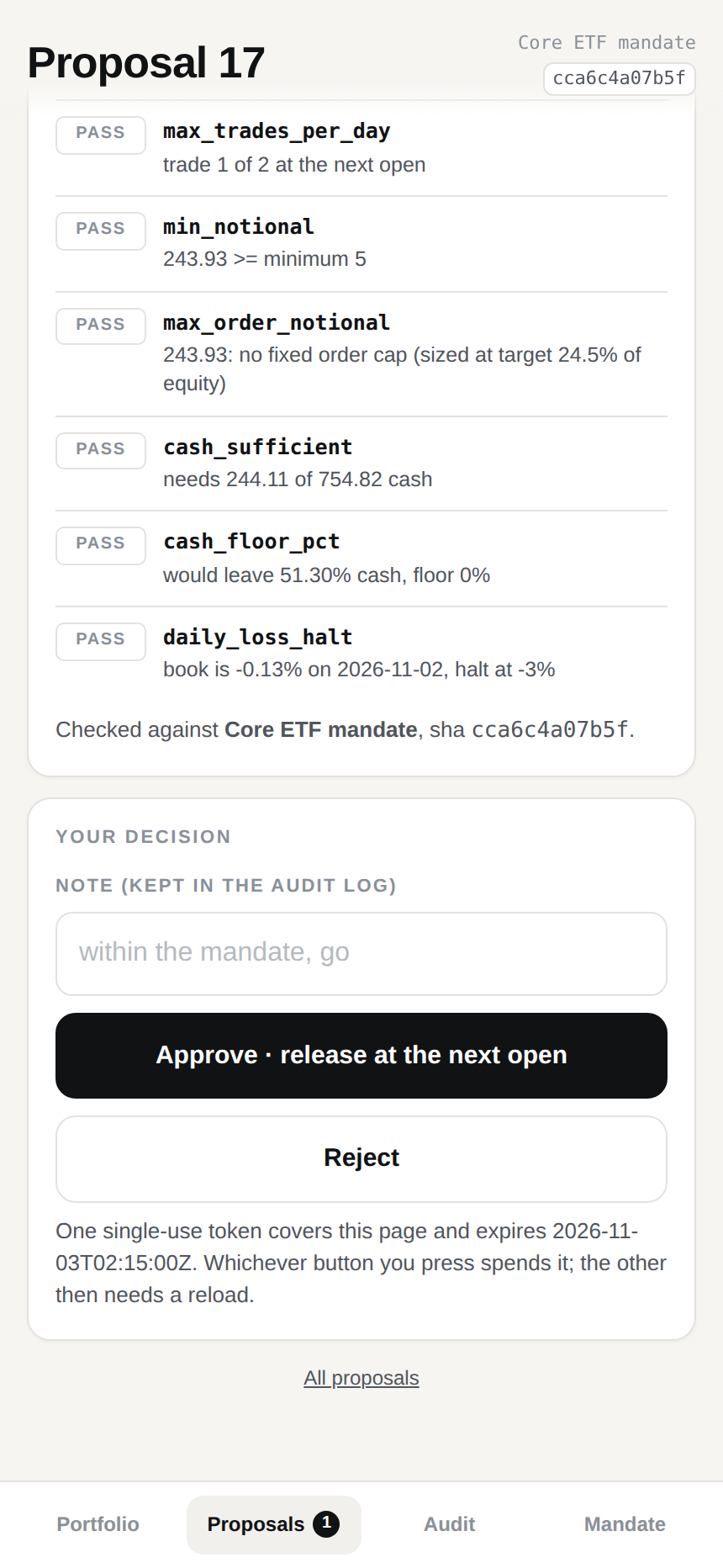
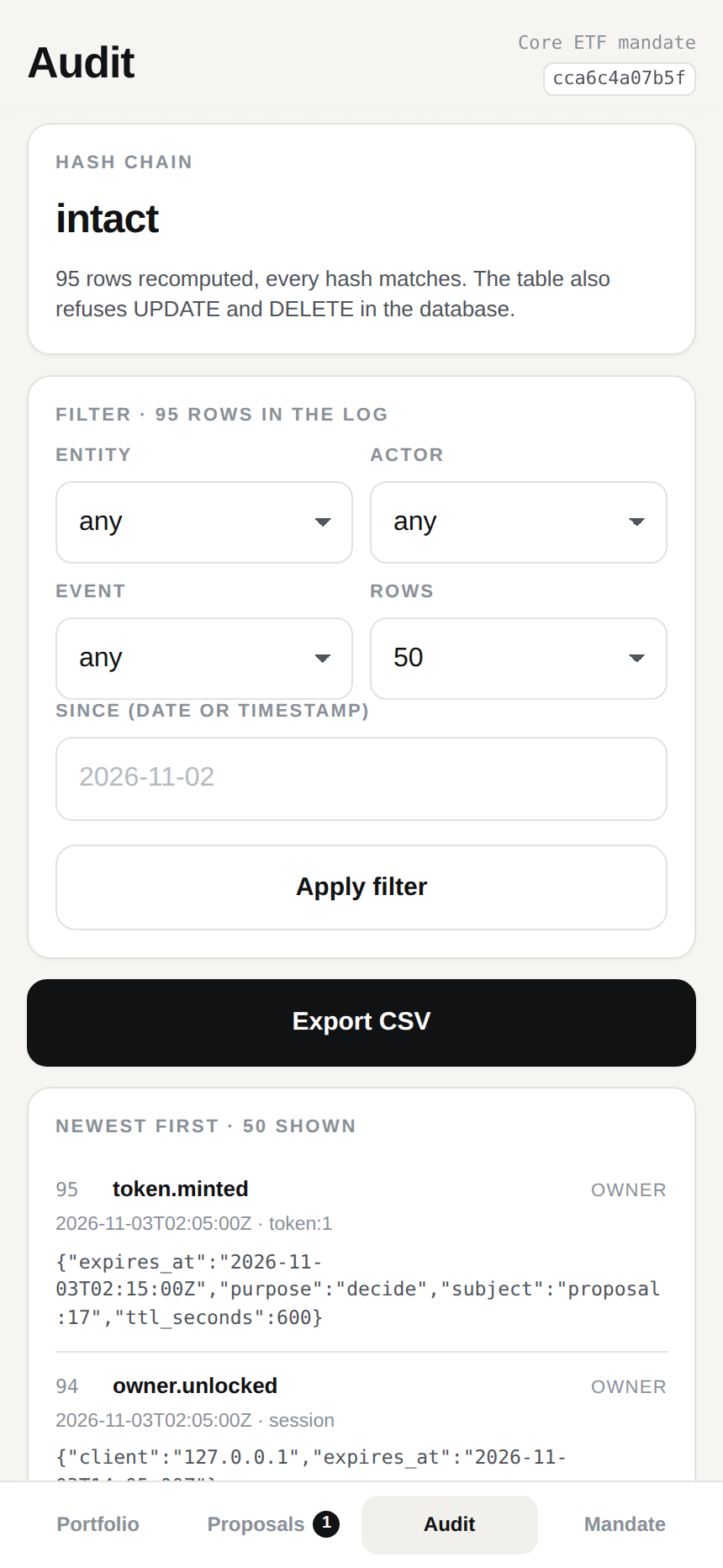
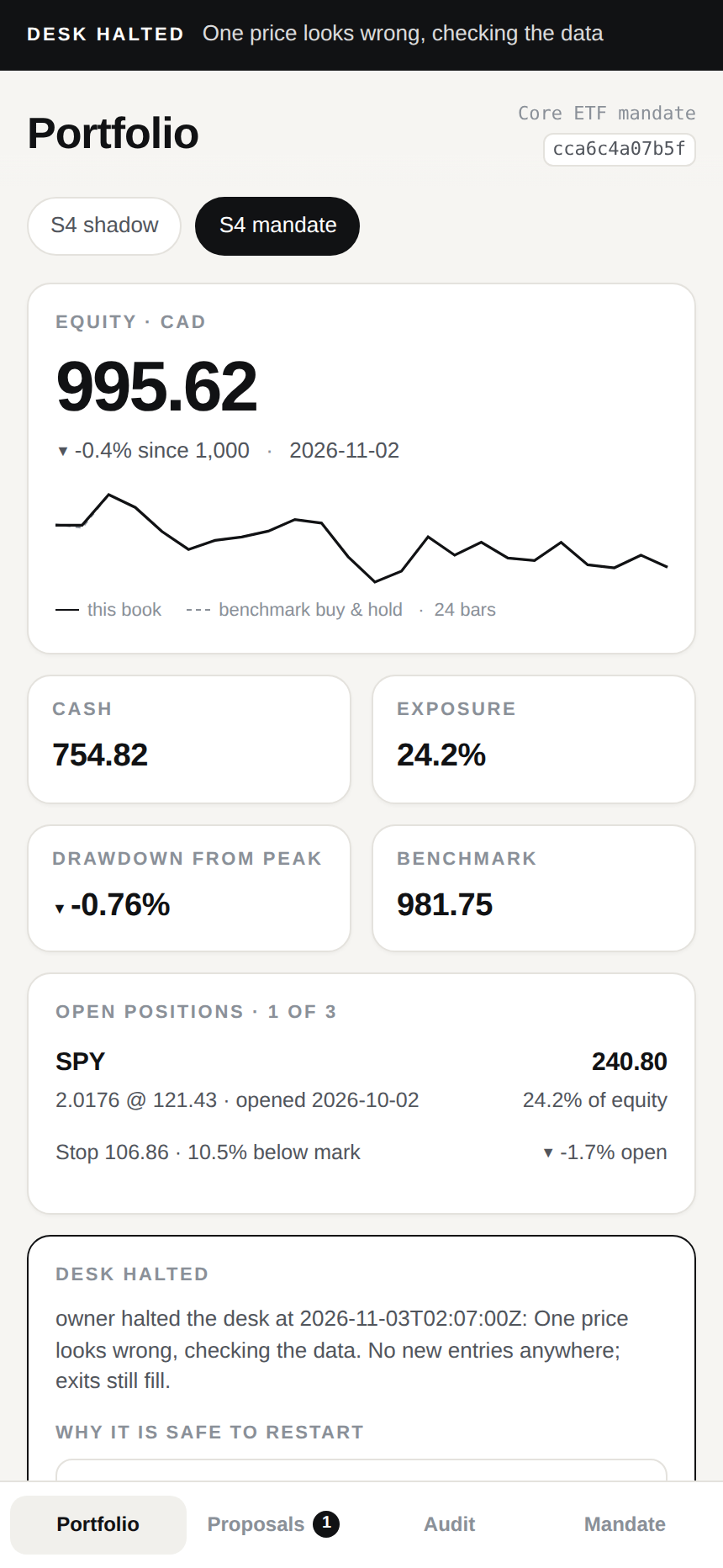
Synthetic data · The real app, run on a throwaway database of invented prices with a made-up starting balance of 1,000. The balances and percentages on these screens are not results, and none of it is my own paper record.
What keeps it on paper
- Paper hosts only — one file talks to each broker. One is pinned to the broker’s paper host; the other connects only to a gateway on the same machine and refuses any account that is not a paper account.
- A tripwire test — the test suite fails if a live trading host or a live port number appears anywhere in the project.
- No way to move money — the broker interface has no transfer, withdrawal or live switch, and a test pins that list.
- The rule file refuses — a mandate whose mode is not “paper” does not load.
- One kill switch — it holds back new buys in every book, approved ones included. Sells still go.
- Reconciliation — when the broker account and the books disagree, the kill switch engages and I get an alert.
- Paper money only: no live endpoint, port or key.
A result
Day trading failed
its audit.
On 24 November I asked for day-trading rules to be tested next to the long-term ones. Three were written down with their settings, costs and pass marks before the first backtest ran. All three failed.
| Idea | Verdict | Why |
|---|---|---|
| Opening-range breakout, two ETFs | Failed | A small edge before costs, about three and a half times smaller than the cost of one round trip. |
| Reversion to the day’s average price, three ETFs | Failed | Lost money even before costs. |
| Crypto breakout in set hours, three coins | Failed | A small edge before costs, more than four times smaller than the cost of one round trip. |
None passed, so none joined the scheduled paper books, and the settings were not widened after the numbers came in. Every setting tried is counted: the project’s trial count went from 216 to 225. The code is on a branch, not merged; nothing was scheduled and no order was placed.
What works / what doesn’t yet
Running, as of 25 Nov 2026
The daily paper run (prices for six ETFs, the strategy, the log), the Desk’s forecasts, scheduled jobs for two brokers’ paper accounts, eight experiment books, and a private phone app behind a login. 1,176 automated tests pass.
Not yet
The monthly rule had still not proposed a trade by 25 November: it next decides at the first session of December, so the approval step has run only in tests and one test alert. My original internal run is still hands-off by my own choice; the broker-paper books always wait for me. The first weekly scorecard for the experiment books is due on 29 November. Broker sell fees of a few cents are counted for the account but not yet charged to a book. No performance figure is reported here.
Working with agents
I set the direction;
agents planned and wrote it.
I asked for a trading system that starts on paper and stays behind hard limits, my sign-off and a kill switch. An AI agent proposed making those controls the product and wrote the plan as small slices. Other agents implemented each slice with tests and a handoff note: what was done, what was not, and open questions for me. I made the early calls they sent back; for example, order size follows a percentage of the account, not a fixed dollar cap. I don’t hand-code it.
What I learned
What stops a trade
is the bigger part.
A review is part of the build. On 25 November it found that the kill switch did not hold back buys I had already approved. The fix came with a test that failed first.
Installing a fix can cause the fault. Loading the corrected schedule started four jobs at once during market hours. Two were stopped twenty seconds later, the other two did nothing, and no order was sent.
Written in one file the program must load, a rule is checked on every proposal, and a changed rule leaves a trace.
Switching a control off is also a decision. My hands-off paper run is its own rule file, with the decision and its date written at the top, so the exception is on record.
Next: the first shared-account orders and the first scorecard.
Planned for the morning of 27 November: the five ETF experiment books start placing their orders at a broker’s paper account instead of only in the internal ledger. Planned for 29 November: the first weekly scorecard. Planned, not done.
Since 17 November 2026 a second part, the Desk, logs daily forecasts on ETF questions and runs a simulated SPY book. Its record has its own page.
Paper money only, no real-money orders, not advice.
Contact.
LinkedIn or student email.